
Eco-Friendly Home Improvements: A Complete Guide to a Greener
Eco-Friendly Home Improvements
Most homeowners think about eco-friendly home improvements at some point — but a lot of them don’t know where to actually begin, or they start with the wrong thing entirely.
That’s a real problem. Because the order in which you make these changes matters just as much as the changes themselves. Spend money on solar panels before fixing your insulation, and you’ve just paid a premium to power an inefficient house. Get the sequence right, and every upgrade you make builds on the last one.
This guide lays out what actually works, what the research says, and — just as important — what the limitations of that research are. Savings figures in particular vary heavily by country, climate, home size, and energy prices. Where numbers come from U.S.-specific data, that’s noted clearly.
1. Insulation and Air Sealing: Fix This First
Here’s something most people don’t realize until they’ve already wasted money elsewhere: the single most impactful thing you can do to an existing home is seal it properly and insulate it correctly. Not solar. Not a new HVAC system. This.
The U.S. EPA puts it plainly — 25 to 40 percent of a home’s heating and cooling energy escapes through air leaks. Gaps around foundations, pipes, attic hatches, and window frames. Small individually, enormous collectively. And about 90% of American homes are under-insulated to begin with, according to Energy Star.
That’s a staggering baseline. It means almost any home has room for serious improvement here before touching anything else.
What the research says: The right combination of professional air sealing and insulation can cut a home’s total energy waste by up to 45%, according to data cited by the Insulation Contractors Association of America. That’s not a small number.
One important caveat: this is not DIY work. Building science, home ventilation, and moisture control are all connected. Seal a house too aggressively without accounting for airflow and you trap humidity — which leads to mold, structural damage, and air quality problems. Professional contractors use blower door tests to measure exactly how airtight a home is and where the leaks are. That data drives the actual work.
On ROI estimates: Various industry sources report return-on-investment figures for insulation upgrades ranging from around 80% to over 100%. These vary widely based on local labor costs, climate zone, and existing insulation levels. Treat any specific figure as a rough benchmark, not a prediction.
Practical starting points:
- Blown-in insulation for attics and wall cavities — reaches places batts can’t
- Professional blower door testing to find and quantify leaks
- Foam sealing around pipes, wiring penetrations, and attic hatches
- Weather stripping and caulking on doors and windows — cheap and often underestimated
2. Energy-Efficient Lighting: Start Here If Budget Is Tight
If you can only do one thing right now, swap your bulbs. LED lighting uses up to 90% less energy than incandescent bulbs — that’s a verified figure from the U.S. Department of Energy, not a marketing claim. For an average U.S. household, that translates to roughly $225 saved per year on electricity. In other countries, your savings will depend on local energy pricing.
Unlike older compact fluorescent bulbs, LEDs contain no mercury. They last significantly longer too, which means less replacement cost over time and less waste going to landfill.
Beyond the bulbs themselves, how a home is designed around light matters. South-facing windows in colder climates capture solar heat gain passively in winter, reducing heating demand without any mechanical system involved. Skylights and well-placed glass doors cut artificial lighting needs during the day. And light-colored window coverings in summer reflect heat before it enters — less work for the air conditioner, lower bills.
None of this is complicated. That’s the point. These are low-barrier changes with real, measurable impact.
3. Solar Energy: Powerful, But Sequence Matters
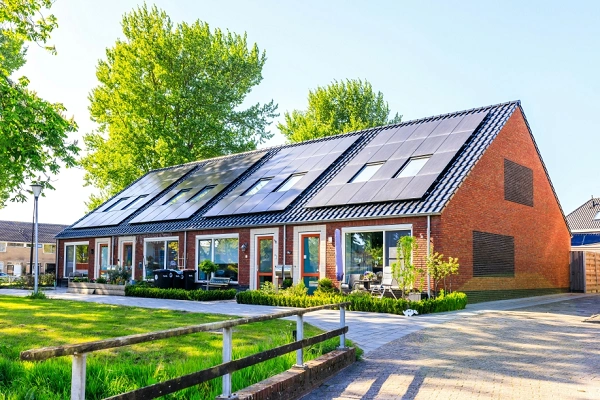
Solar panels have become genuinely affordable. The Solar Energy Industries Association (SEIA) reports the cost has dropped more than 70% over the past decade. That’s remarkable, and it’s changed the math for a lot of homeowners.
Zillow research in the U.S. found solar installations can add over 4% to a home’s market value in certain markets. But — and this is worth saying clearly — that figure is U.S.-specific and market-dependent. It doesn’t translate directly to other countries or housing markets with different buyer priorities.
The sequencing problem: If your home leaks 25–40% of its conditioned air through gaps and poor insulation, every unit of solar energy you generate is partly going to waste. Fix the building envelope first. Solar panels work hardest — and pay back fastest — in an efficient home.
Solar isn’t just panels on a roof either. If you’re interested, here are some other choices:
- Solar attic fans — pull hot air out of attic spaces in warm climates without drawing from the grid
- Solar water heaters — water heating makes up roughly 20% of U.S. residential energy use (DOE), and solar thermal systems cut into that directly
- Outdoor solar lighting — pathway lights, flood lights, and decorative lighting powered by built-in lithium batteries; no wiring needed
4. Heat Pumps: The Upgrade That Changes Everything
If your HVAC system is aging, replacing it with an electric air-source heat pump is probably the single highest-impact mechanical upgrade available right now. Heat pumps move heat around, not make it. That fundamental difference makes them dramatically more efficient than systems that burn fuel or use electric resistance coils.
In summer, a heat pump pulls warm air out of your home and pushes it outside. In winter, it runs in reverse — extracting heat from outdoor air and bringing it in. Yes, even when it’s cold outside. Modern cold-climate models work reliably well below freezing.
DOE efficiency data: Heat pumps deliver 1.5 to 3 times more heat energy than the electrical energy they consume. That’s not a claim — it’s physics. Moving energy requires far less power than creating it from scratch.
For homes currently running on heating oil or natural gas, electrification also improves indoor air quality. Combustion appliances — gas furnaces, oil boilers — release carbon monoxide, nitrogen dioxide, and fine particulates into living spaces. Remove the combustion, and the air gets cleaner. That’s a benefit that rarely makes it into the financial ROI calculations, but it’s real.
Pair a heat pump with a smart thermostat and the efficiency gains compound further. Smart thermostats learn usage patterns, pre-heat or pre-cool before you arrive, and stop wasting energy on empty rooms. Nest published a study showing 10–12% heating savings and 15% cooling savings among their customers — but that’s company-commissioned research on their own product, not an independent finding.
No large-scale independent study has established a universal savings range for smart thermostats, because results depend too heavily on home size, climate zone, occupant behavior, and what system the thermostat is controlling. The honest answer is: savings are real for most households, but the exact number is impossible to predict without knowing your specific situation.
5. Energy-Efficient Appliances: Replace Smart, Not Fast
The advice here is simple: don’t rush out and replace every appliance at once. Wait until something needs replacing, then make the right choice. ENERGY STAR certified models — verified by the U.S. EPA and Department of Energy — use measurably less energy than standard alternatives without sacrificing performance.
When shopping, check the yellow EnergyGuide label. It shows estimated annual running cost based on average usage. It’s not perfect, but it makes comparison straightforward.
| Appliance | What to Know | Realistic Savings |
| Refrigerator | Models 15+ years old use significantly more electricity | Varies by age and size of old unit |
| Washing Machine | High-efficiency models adjust water to load size precisely | Reduced water and energy per cycle |
| Heat Pump Water Heater | 2–3x more efficient than resistance heaters (DOE verified) | Up to $350/year for a U.S. family of four (Energy Star estimate) |
| Smart Thermostat | Nest’s own customer study reported 10–12% heating and 15% cooling savings; treat as a company estimate, not an independent figure | Results vary by home size, climate, and occupant behavior |
| Dishwasher (ENERGY STAR) | Uses less water than hand-washing in most real-world scenarios | Reduced water and energy per cycle |
Heat pump water heaters stand out here. The U.S. Department of Energy confirms they’re 2 to 3 times more efficient than standard electric resistance water heaters. Since water heating is one of the largest single energy expenses in most homes, the long-term impact of this swap is significant — though the $350 annual savings figure applies to U.S. energy prices and a family of four specifically.
6. Windows and Doors: Diagnose Before You Replace
The U.S. Department of Energy estimates about 30% of home energy is lost through windows. That sounds like a strong case for replacement. But before spending $15,000–$20,000 on new windows, it’s worth asking a simpler question: is the problem actually the window, or is it what’s around it?
A lot of drafts that homeowners attribute to windows come from gaps in the surrounding wall assembly, or from air moving through the attic and down into the frame. A new window installed into a leaky rough opening will still let air through.
Quick test: hold a lit candle near a window frame edge. Air is getting in if the flame moves. Then check where — the glass, the frame, or the surrounding wall. The answer changes what you should fix.
If replacement genuinely makes sense, double-pane or triple-pane windows with low-emissivity (low-E) coatings make a real difference in thermal performance and solar heat gain control. Energy Star estimates replacing single-pane windows saves $101–$583 per year in U.S. conditions. The payback period is long given installation costs, which is why professional home performance contractors often recommend sealing and insulation first.
7. Sustainable Building Materials: The Part Most People Skip
Energy efficiency gets most of the attention in eco-friendly renovation conversations. Materials get far less — and that’s a gap worth closing. Every building material carries an embodied carbon cost: the emissions generated in extracting, manufacturing, and transporting it. Choosing better materials reduces that footprint even before the building is occupied.
Some options that have gained real traction in the renovation market:
- Bamboo flooring — grows to harvestable size in a few years versus decades for hardwood; comparable durability
- Cork flooring — harvested by stripping bark without felling the tree; naturally antimicrobial and comfortable underfoot
- Reclaimed wood — structurally sound, often available cheaply through salvage networks, and reduces demand for new timber
- Quartz countertops — long lifespan, low maintenance, and largely composed of natural quartz with minimal binders
- Recycled-content insulation — cellulose insulation made from recycled paper, or products made from recycled denim or glass fiber
Paint is worth a separate mention. The U.S. EPA classifies volatile organic compounds (VOCs) — found in many conventional paints — as harmful chemicals that off-gas into indoor air after application and during drying. Short-term exposure causes irritation; long-term exposure is linked to more serious health effects. Low-VOC and zero-VOC paints are now standard offerings from major brands at similar price points. Simply put, don’t hesitate to use them.
8. Water: The Overlooked Resource in Sustainable Homes
Energy gets most of the focus in eco-friendly home discussions. Water tends to get treated as an afterthought. That’s a mistake — especially in regions facing increasing drought and rising water costs.
Low-flow fixtures certified under the EPA’s WaterSense program use at least 20% less water than standard models while meeting strict performance standards. Showerheads, faucets, toilets — small changes that add up significantly over a year of daily use.
Composting is another underrated move. The EPA reports that food scraps and yard waste make up more than 30% of what average households throw away. A compost bin converts that waste into usable organic matter for soil — reducing landfill contribution and cutting the need for synthetic fertilizers at the same time. The setup cost is minimal.
Outside, native plant landscaping does more work than most people realize. Native plants have gotten used to the way it rains where they live. They need less or no supplemental irrigation, support pollinator habitats, reduce soil erosion, and improve local biodiversity. And unlike some eco-friendly improvements, they often add genuine curb appeal rather than being invisible.
9. The Return Nobody Talks About: Health and Comfort
Energy bill savings and resale value get all the attention when people calculate the return on eco-friendly upgrades. But there’s a third return that’s harder to put a number on and rarely gets discussed: how it actually feels to live in the house.
A properly sealed and insulated home with good indoor air quality is a different experience from a drafty, dusty, poorly ventilated one. No cold spots by windows in January. No stuffiness in upstairs bedrooms in July. Less dust circulating. Less mold risk from controlled moisture. These things affect sleep quality, concentration, and how much energy people have day to day.
Peer-reviewed research consistently links thermal comfort, clean indoor air, and natural light to reduced physiological stress, lower blood pressure, and measurably better cognitive performance. That research exists. It just doesn’t fit neatly into a payback period calculation, so it gets left out of most renovation guides.
On the financial side: homes certified through programs like LEED, Energy Star, or Pearl Certification have commanded price premiums in studied markets — but the size of that premium varies significantly by location. What’s consistent across markets is that documentation matters. Energy audit reports, utility bill histories before and after upgrades, and receipts for professional work all give buyers something concrete to evaluate. That documentation has value even without formal certification.
10. The Right Order: A Practical Priority Framework
Most guides list eco-friendly improvements without saying which to do first. That’s a problem, because sequence determines whether you get full value from each upgrade or not. Here’s a logical order based on building science — not on what’s most marketed:
- Seal and insulate first. A tight, well-insulated home works better for everything else. Skip this and you’re building on a leaky foundation — literally.
- Switch to LED lighting. Lowest cost, immediate payoff, no prerequisite work required.
- Replace HVAC when it’s time. Don’t rip out a functioning system prematurely. But when it reaches the end of life, replace it with a heat pump — not like-for-like.
- Add a smart thermostat. Inexpensive and effective, especially paired with a variable-speed heat pump.
- Upgrade appliances at end of life. Choose ENERGY STAR certified replacements. Don’t rush it.
- Then consider solar. Once energy demand is reduced and systems are efficient, a solar installation works at its actual potential — and the payback period shortens considerably.
- Apply sustainable materials to planned work. When renovation is already on the schedule, choosing reclaimed wood or low-embodied-carbon materials adds little to no cost.
On financing: many utility companies and government programs offer rebates, tax credits, and low-interest loans for qualifying upgrades. These vary enormously by country, region, and year — and they change. Always verify what’s currently available locally before budgeting for a project. What was true two years ago may not be now.
11. Why These Upgrades Work: The Building Science Behind Them
Understanding the logic behind these improvements — not just the list — helps with making good decisions when situations don’t fit neatly into a guide like this one.
A house isn’t a collection of separate systems. It’s one connected system. If you change one part, it changes the others too. When air sealing reduces uncontrolled infiltration, the HVAC system runs fewer cycles — it’s not compensating constantly for heat loss.
Fewer cycles means less wear and a longer lifespan. When insulation stabilizes interior temperatures, a smart thermostat can work with precision instead of constantly overcorrecting. When solar panels generate electricity, a heat pump uses it at 150–300% efficiency — compared to a resistance heater that uses it at 100% at best.
This is what building scientists call the house-as-a-system approach. It’s not a marketing phrase — it’s a practical framework for making decisions that compound rather than cancel each other out.
Passive house principles take this thinking to its logical conclusion — ultra-low-energy construction through obsessive attention to thermal bridge reduction, airtightness testing, and mechanical ventilation with heat recovery (MVHR). Most homeowners aren’t building to passive house standards. But the principles are influencing how professional home performance contractors approach retrofit work, and that’s pushing the whole industry toward more rigorous, science-based improvement strategies.
Final Thoughts
Eco-friendly home improvements run the full range — from a cheap pack of LED bulbs to a full heat pump and solar installation costing tens of thousands. The logic connecting all of them is the same: use less energy, use it more efficiently, and build a home that works better for the people living in it.
If there’s one takeaway worth remembering, it’s this: get a professional energy audit before spending significant money on upgrades. An audit identifies exactly where your home loses energy, which improvements will have the most impact, and what the realistic numbers look like for your specific situation — not for an average house in a different country.
The savings figures, ROI estimates, and home value premiums in this guide come primarily from U.S. research. They’re useful reference points, not predictions. Your results will depend on your home, your climate, your local energy costs, and your local housing market. Use this guide to understand the principles — then get local advice to make the actual decisions.